
होमKabaddiCommonwealth Kabaddi Championship 2026: India Crush Nigeria, But the Search for a 'Statement Win' Continues
Commonwealth Kabaddi Championship 2026: India Crush Nigeria, But the Search for a 'Statement Win' Continues
2026 कॉमनवेल्थ कबड्डी चैंपियनशिप में भारत ने नाइजीरिया को हराकर अपराजित लय बनाए रखी, लेकिन ईरान की अनुपस्थिति में भारत की जीत दूसरे और तीसरे दर्जे की टीमों के खिलाफ है। इंग्लैंड ने नाइजीरिया के खिलाफ 68 अंक बनाए, जबकि भारत के खिलाफ सिर्फ 26 — यानी भारतीय बचाव मजबूत है, पर हमले में बड़े अंतर की क्षमता पर सवाल बने हुए हैं। कप्तान सुरजीत सिंह की अगुआई वाली टीम ने इंग्लैंड, यूगांडा, मलेशिया और नाइजीरिया को हराया। कॉमनवेल्थ कबड्डी चैंपियनशिप कॉमनवेल्थ गेम्स का हिस्सा नहीं है और इसकी प्रतिष्ठा एशियाई खेलों व कबड्डी विश्व कप से काफी नीचे है। निष्कर्ष: भारत की जीत आरामदायक है, लेकिन वैश्विक प्रभुत्व का प्रमाण नहीं; असली परीक्षा ईरान जैसी टीमों के सामने होगी।
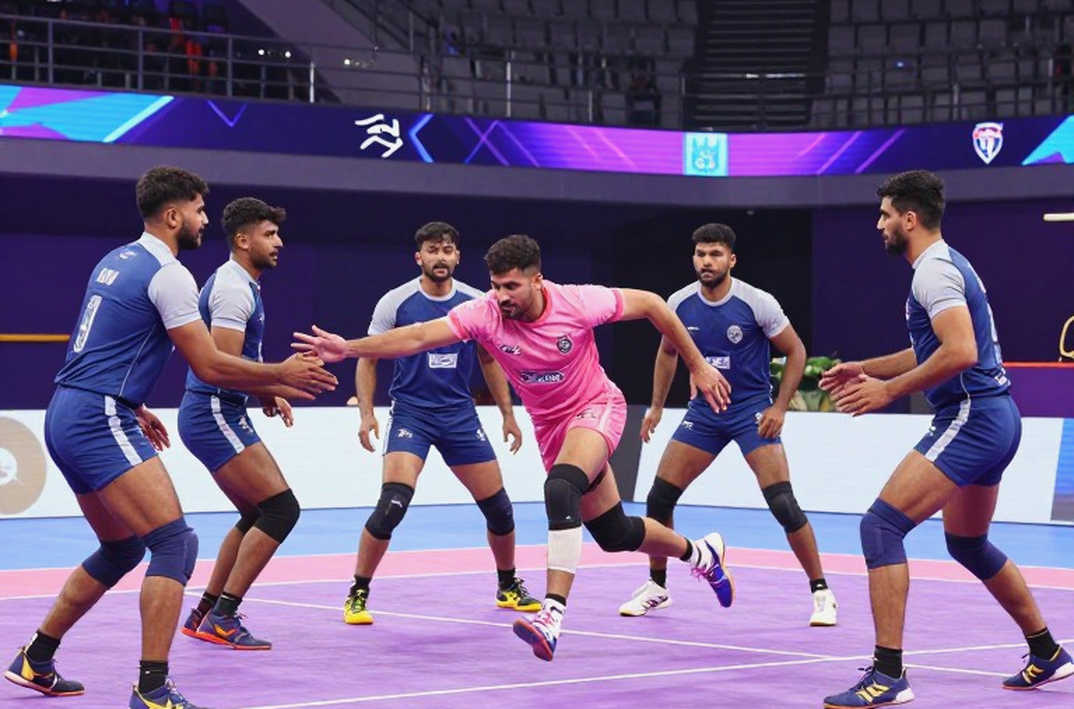
The Indian men's kabaddi team secured a one-sided win over Nigeria on Day 4 of the Commonwealth Kabaddi Championship 2026. Led by captain Surjeet Singh, India had earlier beaten England 46-26, Uganda 44-30 and Malaysia 37-23, and their dominance continued against Nigeria. This unbeaten run has made India the clear favourites in the tournament, but a closer look at the scorelines reveals another picture — India are winning, but not quite in the manner expected of a global powerhouse.
First, a brief primer for readers unfamiliar with kabaddi. Kabaddi is a contact team sport played between two teams of seven. An attacking player, the 'raider', crosses into the opponent's half and must touch a defender and return safely within 30 seconds. Throughout the raid he must continuously chant 'kabaddi-kabaddi' to prove he is not inhaling — the rule that gives the sport its name. The defending side collectively stops the raider in what is called a tackle. When all players of a team are out, the opponent earns two bonus points and the entire team revives — this is the 'All Out'. This rule is the biggest reason for the rapid scoring and large margins in kabaddi. After two consecutive empty raids, the third becomes a 'do-or-die' raid — if it also yields nothing, the raider himself is out. And when a defending side has three or fewer players on court and completes a tackle, it is a 'Super Tackle', worth two points.
Against this backdrop, India's performance needs to be understood. India scored 127 points in three matches and conceded 79 — an average of about 42 scored and 26 conceded per game. The winning margins were 20, 14 and 14 points. These are comfortable wins, but not explosive ones. Compare: against Nigeria, England scored 68-18 and Tanzania 66-17. In other words, England and Tanzania racked up more points against a weak Nigeria than India managed in any of their matches. This is the point that has bred disappointment among Indian fans. Reports say fans expected India to win by big margins, but that did not happen.
But it would be premature to draw conclusions from scorelines alone. The most important data point is the one that directly reflects India's defensive strength — England scored 68 against Nigeria but only 26 against India. India's defence thus suppressed England's attack by 42 points. This is a strong signal that India's defence is functioning at a high level, even if its own attack does not look spectacular. In kabaddi, defence often decides the course of a match, and India have shown they can shut down a good team when it matters.
Still, there is a caveat. India are conceding 23 to 30 points per game. For a team playing against weaker opponents, this can be a concern. If India's defence is 'good enough', it is not 'airtight'. Against a strong team like Iran in a bigger tournament, this could prove costly. And this is where the biggest question arises — Iran are not in this tournament.
Iran's absence is the most important structural fact of this tournament. India and Iran are the two top powers in world kabaddi, and Iran are the one nation that has genuinely challenged India on the big stage. Iran is not a Commonwealth member, so it cannot take part here. The direct implication is that India's winning run has come against tier-2 and tier-3 teams, and these wins may exaggerate India's true superiority. A reader relying solely on this report might overestimate India's global margin, when in reality teams like Iran remain the real challenge.
Looking at the competitive structure of the tournament, three clear tiers emerge. India are alone at the top. England, Tanzania, Malaysia and Uganda form the second tier. Nigeria are at the third tier, having lost by 49 and 50 points. Nigeria's defeats are not merely due to weakness but also due to kabaddi's rules. The All Out revival rule is such that once a team gains the upper hand, it repeatedly forces All Outs and rapidly widens the gap. In other words, large margins arise not only from talent gaps but from the 'amplification' of the rules.
African nations — Nigeria, Tanzania and Uganda — are in the early stages of development. Their presence signals the spread of kabaddi, not competitive depth. The 'Commonwealth' label is an attempt to present the sport as a shared game of the Anglophone world, part of India's soft-power strategy. But it should be remembered that kabaddi is not part of the Commonwealth Games, so this championship is not connected to that prestige ladder. Its standing is well below the Asian Games and the Kabaddi World Cup.
India's example illustrates kabaddi's popularity. It is India's most-watched sport after cricket, rooted in village akhadas and closely tied to job pathways in the railways, police and army. The Pro Kabaddi League has turned this traditional sport into a professional televised product. In the Indian context, kabaddi is what happens when a country's beloved folk sport becomes a professional league. This is why interest in this tournament exists in India, but it is not a major event like the Pro Kabaddi League. This report itself is in the form of a live streaming and telecast guide, indicating that distribution is via online platforms rather than premium mainstream channels and that its commercial weight is limited.
Organisationally, there is a lack of transparency. It is not clear who the organiser is or whether the event has International Kabaddi Federation recognition. Kabaddi has a history of parallel federations and disputed events, so caution is warranted over the 'Commonwealth' branding. The event also does not advance kabaddi's Olympic case, because criteria such as the number of participating countries, continental spread and the depth of the women's game are required — and this tournament does not even include strong teams like Iran and Korea.
For India, the road ahead is clear. Their defence against England was of a high standard, but questions remain over consistency in raiding and the ability to win by big margins. Player-level statistics are unavailable, so it is difficult to say whether India's attack depends on a single raider — and that is a major data gap. As for Nigeria, this championship is a learning experience, not a winning stage.
Overall, the Commonwealth Kabaddi Championship 2026 has woven a story of India's continued victories while also showing that kabaddi's internationalisation is broad but not deep. Many countries, few competitive nations. The real test for India will come against teams like Iran, not in a big margin over Nigeria. And until that test comes, this 'unbeaten run' should not be taken as proof of complete global dominance.
संबंधित खिलाड़ी
अनुशंसित
Surjeet Singh Captain, Naveen Kumar Vice-Captain: Three Questions the Commonwealth Kabaddi Championship Announcement Does Not Answer2026-10-22
After Pakistan's Walkout, the Commonwealth Kabaddi Championship: A Medal That Devalued Itself2026-10-22
Before India Face Uganda: A 46-26 Scoreboard, a 26-Point Leak, and an Incomplete 'Commonwealth' Claim2026-10-25
Pakistan's Last-Minute Kabaddi Withdrawal Cuts the Ahmedabad Field from 14 to 13: A Weakened Draw, an Unanswered Question2026-10-22
Surjeet Singh Captain, Naveen Kumar Vice-Captain: Three Things Missing From the Commonwealth Kabaddi Championship 2026 Announcement2026-10-22
Surjeet Singh Captain, Naveen Kumar Vice-Captain: The Arithmetic That Does Not Add Up in the Commonwealth Kabaddi Championship 2026 Announcement2026-10-22
अनुशंसित
Surjeet Singh Captain, Naveen Kumar Vice-Captain: The Arithmetic That Does Not Add Up in the Commonwealth Kabaddi Championship 2026 Announcement2026-10-22
After Pakistan's Walkout, the Commonwealth Kabaddi Championship: A Medal That Devalued Itself2026-10-22
Commonwealth Kabaddi 2026: Surjeet Singh Captain, Naveen Kumar Vice-Captain — And the Half-Story the Press Release Left Out2026-10-22
Pakistan's Withdrawal Kills the Commonwealth Kabaddi Drama, But That's Not the Real Question2026-10-22
Commonwealth Kabaddi Championship 2026: Surjeet Singh Captain, Naveen Kumar Vice-Captain — The Three Questions the Announcement Leaves Open2026-10-22
Kabaddi's 'Commonwealth' Gamble in Ahmedabad: 62 Matches, 13 Nations, and One Big Question2026-10-22
अनुशंसित
Kabaddi's 'Commonwealth' Gamble in Ahmedabad: 62 Matches, 13 Nations, and One Big Question2026-10-22
Commonwealth Kabaddi 2026: Surjeet Singh Captain, Naveen Kumar Vice-Captain — And the Half-Story the Press Release Left Out2026-10-22
Commonwealth Kabaddi Championship 2026: Surjeet Singh Captain, Naveen Kumar Vice-Captain — and the Three Questions the Announcement Left Unanswered2026-10-22
Pakistan's Last-Minute Withdrawal Dims Inaugural Commonwealth Kabaddi Championship as India's Gold Path Eases2026-10-22
Pakistan's Last-Minute Kabaddi Withdrawal Cuts the Ahmedabad Field from 14 to 13: A Weakened Draw, an Unanswered Question2026-10-22
Surjeet Singh Captain, Naveen Kumar Vice-Captain: The Arithmetic That Does Not Add Up in the Commonwealth Kabaddi Championship 2026 Announcement2026-10-22